Syllabus for PHYS 106
Physics II - Intro to Electricity & Magnetism, Optics & Photonics
with hands-on laboratory
Location and times:
Regular Meetings: MWF 1:00 - 1:50 in room E105 of CNS
Laboratory: Room WS005 of CNS
Physics Discussion Room: 7-9 PM in CNS room E105 on T-Th evenings, and via Zoom with a tutor on Sundays. This Physics Help Clinic is staffed by experienced and friendly members of the IWU Society of Physics Students and of the IWU student chapter of SPIE, which is the international society for optics & photonics, and by student members of our engineering club, IEEE. (You should join these groups!)
Field trips are possible, if there is sufficient clamoring for them, to nearby facilities. This course will expose you to possible new interests via ongoing exploration of cutting-edge projects and, critically, we will enter into (both oral and written) conversation about those projects that you identify as "cool." Connect these to what's already going on locally, whether via student clubs or on-campus research groups and fabrication facilities, or our Mark Evans Observatory. There are a number nearby facilities of relevance, such as FermiLab and CU Aerospace, or Zentech, Inc. (formerly CAMtek), which is focused on advanced electronics manufacture and assembly. There are many advances taking place at Caterpillar, SCADAware Robotics, Identity Optical, Mechanical Devices Company, G3 Machining, the Bridgestone tire manufacturing facility, the State Farm Vehicle Research Facility, the State Farm Building Research Unit, and the local branch of the Army Corps of Engineers. Wolfram is outstanding at innovating computation. Driver assistance technologies are just one focus of AutonomouStuff, and we also have Rivian Automotive, the electric vehicle manufacturer and advanced battery developer. The Ameren Microgrid facility integrates (intermittent) renewable energy sources including wind and solar with backup strategies such as natural gas turbines and battery-based storage facilities. Such research can be traced back to the Department of Energy's Argonne National Lab, which is a critical national asset, moving forward. In town, the EDP Renewables Training Facility is used for training wind power workers from around the country, while the Ecology Action Center aims at community involvement, while our shared IWU GreeNetwork is an action-oriented open group for members of our community who are interested in Environmental issues. Some of our students interested in Architectural/Structural/Civil Engineering have been particularly involved in our on-campus projects. The next big one will have to do with co-generation of energy, through our on-campus GreeNetwork.
"Physics is a liberal arts education for a technological society"
- J. M. Pimbley
Many of the opportunities associated with E&M lie well beyond the realm of common experience but, fortunately, we incorporate into this course a series of regular exercises aimed at broadening your exposure to cutting-edge activities. These take the form of readings, including "news releases" and brief summaries, along with occasional, brief chats.
A pocket calculator will be needed for exams, but for in-class problem sets, and in the lab, you would much be better served by using the Wolfram|Alpha app, on your phone.
"Classic" References: (readings from these open-access sources will be essential):
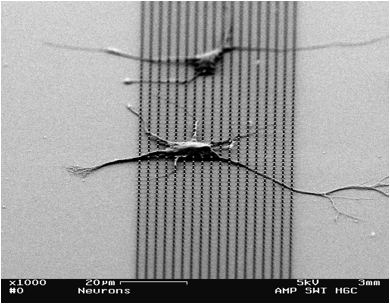
The spring semester, 106, takes up the science and technology of Thomas Edison, Michael Faraday, and James Clerk Maxwell. For much of the term, we will discuss electricity and magnetism (E&M) and explore the rather interesting connections between the two, which introduces the surprises associated with high-speed signals (i.e., the required corrections that arise from Einstein's theory of relativity). Eventually we will branch off from E&M and discuss the wave nature of optics (light is actually related to E&M, as we will see), as well as photonics (noting that there is no continuous stream of energy). The ideas we learn here are of fundamental importance, and have an enormous number of direct applications ranging from modern electronics and instrumentation, to electrical power, to our understanding of plasma in space, to our understanding of neurons (shown above, interfaced to a silicon chip by Harold Craighead's group at Cornell).
At the same time, what we really do is to revisit, reinforce, and refine your understanding of methods you encountered in earlier coursework in Physics (which underly all of engineering, and a great deal of fundamental science). In doing so, we apply the basic notions of Force, Energy, and Momentum, to describe the flow of Information.
Grading:
Laboratory 20% [Note: ALL labs must be completed to pass the course!]
Written exercises 15%
In-term exams add up to a total of: 45%
Final Exam: 15%
Zotero/Participation: 5%
Laboratory: pseudo-notebooks and lab summaries will be due one week after your lab section. This remains true for the final lab meeting, and for any weeks where there is a break in the lab schedule.
Written exercises: the following simple scheme emphasizing understanding
over details will be applied to each problem or substantial part thereof:
4 points will be awarded for a correct numerical answer, logically arrived at; 3 points for correct application of concepts; 2 points for a significant attempt with conceptual
errors; and 1 point for any attempt.
Exams: conceptual understanding of the underlying principles is key, but you will also need to be able to use these concepts to quantitatively solve problems about the physical world. On the exams, partial credit may be awarded for sensible efforts even without completely correct answers. Policies on lateness and absences:
Follow the schedule of assigned readings and pre-meeting activities, which is designed to prepare you for active participation during class meetings. It is important that you attend all class meetings in order to benefit from this course and fulfill your responsibilities as a participant. There will be a 20% penalty for any unexcused absence from the regularly scheduled laboratory period, and unexcused absences from other class meetings will also be noted, impacting your grade.
Labs must be completed and turned in on the due dates unless cleared
in advance by the lab instructor.
Homework: Turn homework in at the start of class, on the date it is due. You are permitted a single one week extension without
any penalty during the semester when you are stressed out with work; however,
in order to receive the extension you must, at the time the homework is
due, turn in a dated sheet of paper indicating that you are giving yourself
a "free extension." Save it for when you really need it.
Otherwise, work turned in by the start of the next class following the due date
will be assessed a modest 15% penalty.
Work handed in anytime after that,
but before the end of the semester deadline, will not be graded but will
be given about 1/3 credit for a reasonable effort.
Please do not split
up the assignments.
Exams must be taken at the stated times, except by prior agreement.
Honor code matters:
We value Illinois Wesleyan's honor code for the integrity it fosters
and the pedagogical flexibility it affords. The important guiding principle
of academic honesty is that you must never represent the work of others
as your own. The following guidelines should govern your behavior in the
course; please request clarification if you find yourself in any doubtful
situations.
You may seek assistance from the instructors, at the Physics clinic
or from your fellow students with the weekly assigned exercises and with
preparing for class discussions. You may also work together with other
members of the class on these assignments, and this is often quite beneficial. (It is worth noting that research on study groups suggests that the most effective group size is likely 3 or 4 people, and that all-male groups are the least effective.)
For your own good, avoid situations in which you contribute either
too much or too little to such collaborations. Just copying someone else's
work is clearly a representation of another's work as your own and is a
violation of the community. [This includes copying the homework solutions
when preparing your extension homework.] Your textbook gives the answers
for most of the odd-numbered questions and problems. These are given so that you will
know if you have solved problems correctly. It is not sound learning procedure
to try to work backwards from given answers, but doing so is not a violation
of the honor code.
Solutions to a number of the written exercises will periodically be posted to Piazza. (If you are doing a late set for 1/3 credit, you may consult the solutions, but you may not copy them.)
Exams must be entirely your own work. Detailed instructions will be given
on the exams themselves and discussed in advance. You will be allowed to
use a page of notes prepared in advance and a calculator, but no other
materials will be permitted. No collaboration of any sort is allowed once
an exam begins.
(In CNS room C006B)
Monday: 2:00 - 2:50PM
Wed. or Fri.: 2:00 - 3:50PM
...or by scheduling time via my public calendar
...or by posting (even anonymously, at any hour) to our Class Discussion Page on Piazza
Because much of our discussion involves equations (for which email is not ideally equipped), and because it is nice to have a central repository for those discussions, our primary shared, electronic form of communication is not email, but is via the Class Discussion Page on Piazza, so please check the desktop version of this site regularly. (There is also a free smartphone app for Piazza, and while it can display equations beautifully, it is not as useful as the desktop version when you wish to enter equations yourself.)